Isn’t a chequing account the same thing as a savings account, but with more access to your money? Is one better than the other? Do you really need two accounts, and what’s the point?
This guide breaks down what each account is for, how they compare on fees, interest, and access, when to use each one, and how much to keep in each.
What is a chequing account?
A chequing account is a “transactional” account, meaning the bank expects the account holder to make frequent transactions with the money deposited in it. Transactions include depositing and withdrawing cash, using your debit card to pay for things, and having money electronically wired into your account.
There are chequing accounts available to students (usually with no fees attached), corporate accounts used by businesses, and joint accounts, usually used by married couples.
Unless otherwise determined by the bank, chequing accounts usually have some type of fee associated with them. Fees can be charged when you use an ATM, when you use your debit card abroad, or when you overdraw your account. Sometimes chequing accounts hit you with a combination of all those fees (boo).
What is a savings account?
A savings account, on the other hand, is not really meant for transactions. Its purpose is to provide a safe place to store your money long-term. As financial advisors often point out, it gives you a foundation to fall back on:
Since the money in a savings account is used by banks to make loans to other people, the bank will pay you interest on your balance. Returns probably aren’t going to be as high as those you’d receive if you were to start investing. But it’s the stability of savings accounts that makes them a worthwhile financial tool, with any interest earned as a kind of bonus.
You can open a tax-free savings account (TFSA) and benefit from all the tax breaks that come with it. The word “saving” might be a little confusing because you can actually use these accounts to save or invest. As the name suggests, the major advantage of these accounts is that interest earned is tax-free.
Chequing vs. savings account: how they compare
When you compare a chequing and a savings account, the differences boil down to accessibility, fees, and interest. A chequing account is useful for everyday financial transactions and purchases. A savings account is a safe place to store money, and it accumulates interest because the bank uses that money to make loans to other people.
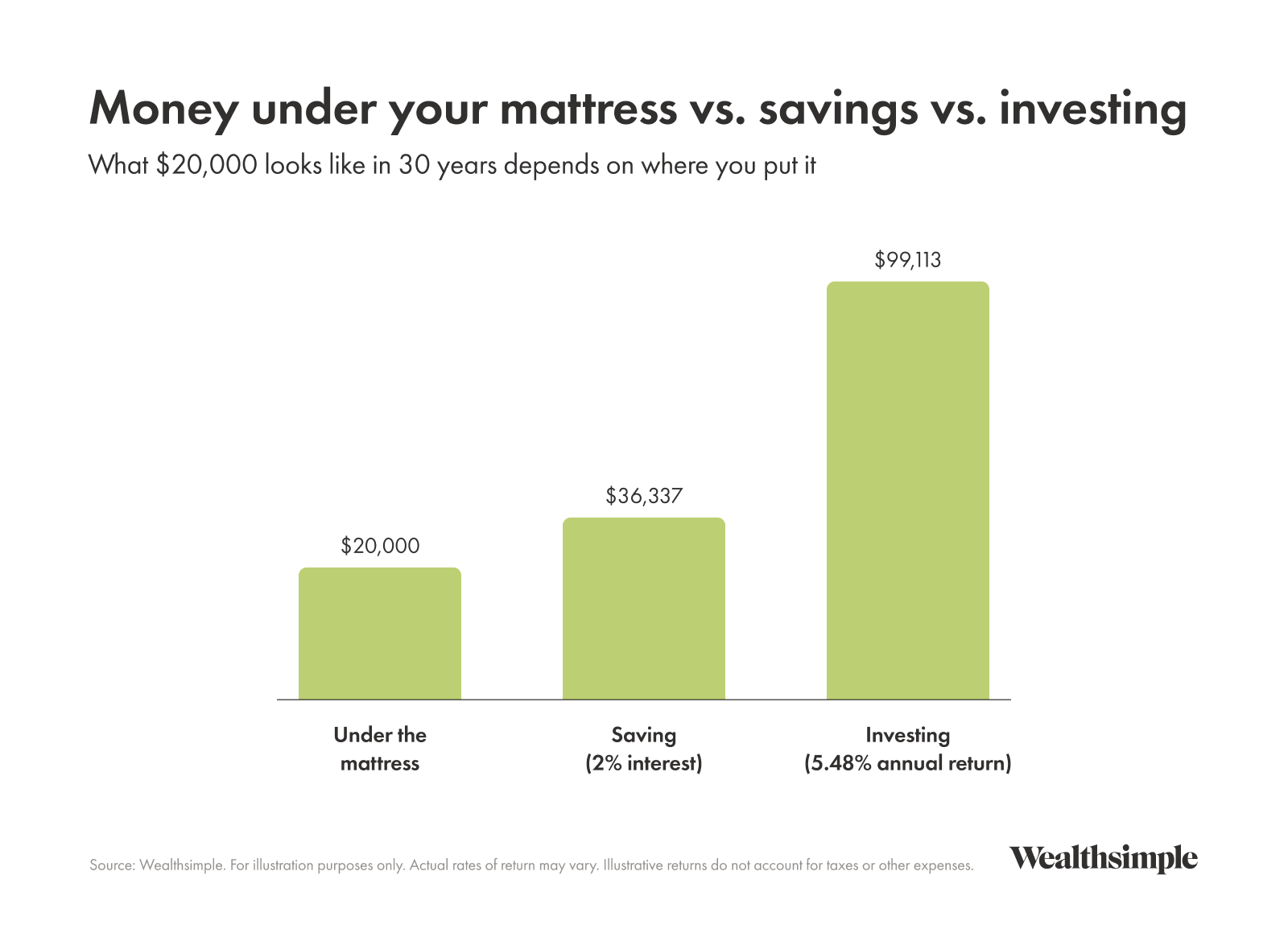
You might be wondering why you’d bother with a savings account if you could invest your money into a low-fee diversified portfolio. But a savings account is a foundation. It supports other types of investing, allowing you to keep a certain amount of funds safe and sound, unaffected by the ups and downs of markets.
While the money in a savings account is harder to access than money in a chequing account, a savings account still has more liquidity than the money you invest. Plus, you get (modest) returns without any of the risks associated with investing your money. Should you ever need money immediately, it’s there and can be withdrawn or transferred to your chequing account without the market-loss risk that comes with investing.
Feature | Chequing account | Savings account |
|---|---|---|
| Main purpose | Everyday spending and transactions | Storing money and earning interest |
| Interest | Little to none | Earns interest on your balance |
| Accessibility | High — debit card, ATMs, cheques, transfers | Lower — designed for fewer withdrawals |
| Fees | Often has monthly or transaction fees | Usually few to no fees, but limits may apply |
| Well suited for | Bills, groceries, and day-to-day purchases | Emergency funds and short-term goals |
Pros and cons
The differences between a chequing and a savings account boil down to accessibility, fees, and interest.
Pros and cons of a chequing account
Pro: Offers high accessibility through debit cards, ATMs, cheques, and mobile banking
Con: Usually charges fees
Con: Earns little to no interest, and tempts you to spend since you’re always dipping in for groceries, impulse buys, and Saturday night bar tabs
Pros and cons of a savings account
Pro: Charges few to no fees, though some banks require a minimum balance or regular deposits
Pro: Pays interest on your balance, though rates vary widely
Pro: Offers tax-free returns inside a TFSA
Con: Isn’t designed for frequent withdrawals, and some banks limit how much and how often you can take money out
When to use a savings account over a chequing account
At the end of the day, it comes down to your financial goals and habits. As mentioned above, it helps to think of a chequing account as an everyday kind of deal: you use it to pay for your morning coffee, drinks with coworkers, IKEA runs, and everything else that makes up the tapestry of your daily life.
You should be using a savings account for something you’re aiming to pay (or pay off) within 3 years — whether that be a vacation, a down payment on a house, or the taxes you know you’ll owe. A savings account is a good place to put your emergency fund — money you’ll want on hand in case of job loss or any other unforeseen expenses. As a rule, it’s recommended to keep 3 to 6 months’ worth of expenses saved up in your emergency fund.
How much money should you keep in each account?
A simple approach is to keep enough in your chequing account to cover your regular monthly expenses — rent or mortgage payments, utilities, and groceries — plus a small cushion. That keeps your day-to-day spending covered without leaving too much money sitting idle.
Everything else can go into your savings account, where it earns interest and stays separated from your spending money. A common guideline is to hold 3 to 6 months of expenses as an emergency fund, along with any money you’re setting aside for goals within the next few years.